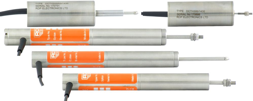
RDP DCV Series Isolated 0 to 10V Output Displacement Transducer 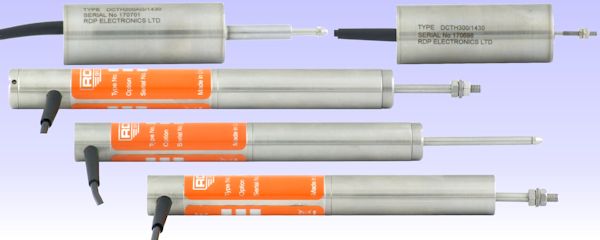 | | These transducers are for displacement / position measurement. They make an accurate position measurement of the movement of the armature (the sliding part) relative to the body of the displacement transducer. This transducer uses the Linear Variable Differential Transformer (LVDT) principle which means that it is probably the most robust and reliable position sensor type available. The strength of the LVDT sensor's principle is that there is no electrical contact across the transducer position sensing element which for the user of the sensor means clean data, infinite resolution and a very long life. Our DC to DC LVDT transducer has all of the benefits of the LVDT sensor principle with the added convenience of built-in LVDT electronics enabling a dc supply and dc output. This series of displacement transducer is available as either an unguided, captive or spring return version. |
| Model DCV variants | Range |
|---|
| Unguided core, axial cable exit | 5mm to 20mm | | Unguided core, radial cable exit | 25mm to 400mm | | Captive core, radial cable exit | 25mm to 940mm | | Spring return core, axial cable exit | 25mm to 20mm | | Spring return core, radial cable exit | 25mm to 40mm |
| DCV Basic Specification | Values |
|---|
| Excitation/supply (acceptable) | 14V to 26Vdc, 30mA | | Output Signal | 0V to 10V (0V=inward full scale) | | Output load | 2KΩ | | Output Ripple | 30mV (peak to Peak) | | Analogue output bandwidth | 200Hz | | Linearity error (Standard) | ±0.5% F.S. | | Linearity error (Optional on some models) | ±0.25% F.S. | | Linearity error (Optional on some models) | ±0.1% F.S. | | Temperature coefficient (span) | ±0.03% F.S. (typical) | | Operating temperature range | -40°C to 70°C | | Electrical termination | 2m (integral cable) Longer available to order. |
RDP DCW Series Submersible DC to DC LVDT Displacement Transducer
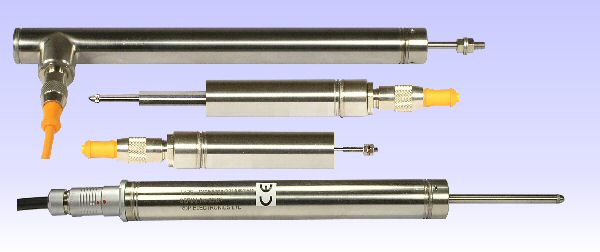 | These transducers are for displacement / position measurement. They make an accurate position measurement of the movement of the armature (the sliding part) relative to the body of the displacement transducer. This transducer uses the Linear Variable Differential Transformer (LVDT) principle which means that it is probably the most robust and reliable position sensor type available. The strength of the LVDT sensor's principle is that there is no electrical contact across the transducer position sensing element which for the user of the sensor means clean data, infinite resolution and a very long life. Our DC to DC LVDT transducer has all of the benefits of the LVDT sensor principle with the added convenience of built-in LVDT electronics enabling a dc supply and dc output. As an option we can offer a 4-20mA 2 wire connection to the transducer on some models. Our submersible displacement transducers are designed to make measurements whilst submerged in suitable liquids. Fluids which are non-magnetic can be allowed to flood the armature tube without affecting the operation of the transducer. This series of displacement transducer is available as either an unguided, captive or spring return version.
July 2019 RDP has annouced some new features will be added to the DCW range |
| Model DCW variants | Range |
|---|
| Unguided Core, axial connector exit | ±2.5mm to ±200mm | | Capitive guided core, axial connector exit | ±12.5mm to ±475mm | | Spring Return, axial connector exit | ±2.5mm to ±75mm |
| DCW Basic Specification | Values - Voltage output |
|---|
| Supply voltage (dual) | ±12V to ±20V | | Supply voltage (single, must be floating) | 24V to 40V | | Change in output for change in supply | 5mV/V | | Output ripple | 30mV (peak-to-peak typical) | | Analogue output bandwidth | 200Hz | | Operating temperature range | -50°C to 80°C | | DCW Basic Specification | Values - 4-20mA output |
|---|
| Supply voltage (Vs) | 12V to 36V | | Max loop resistance | (Supply voltage-11) x 50Ω | | Output ripple | 50µA (peak-to-peak) | | Analogue output bandwidth | 250Hz | | Operating temperature range | -10°C to 70°C | | DCW Basic Specification | Values in common |
|---|
| Linearity error (Standard) | ±0.5% F.S. | | Linearity error (Optional on some models) | ±0.25% F.S. | | Linearity error (Optional on some models) | ±0.1% F.S. | | Temperature coefficient (span) | ±0.03% F.S. /°C (typical) | | Maximum static pressure | 21MPa |
RDP LDC Series DC to DC LVDT Displacement Transducer
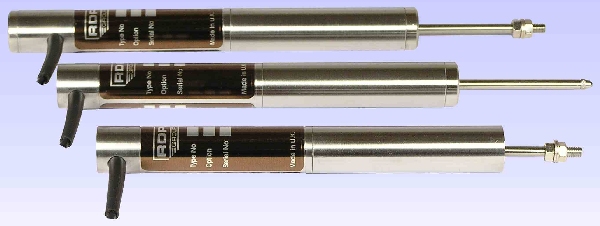 | | These transducers are for displacement / position measurement. They make an accurate position measurement of the movement of the armature (the sliding part) relative to the body of the displacement transducer. This transducer uses the Linear Variable Differential Transformer (LVDT) principle which means that it is probably the most robust and reliable position sensor type available. The strength of the LVDT sensor's principle is that there is no electrical contact across the transducer position sensing element which for the user of the sensor means clean data, infinite resolution and a very long life. Our DC to DC LVDT transducer has all of the benefits of the LVDT sensor principle with the added convenience of built-in LVDT electronics enabling a dc supply and dc output. This series of displacement transducer is available as either an unguided, captive or spring return version. |
| Model LDC variants | Range |
|---|
| Unguided core, radial cable exit | ±12.5mm to ±200mm | | Captive guided core, radial cable exit | ±12.5mm to ±470mm | | Spring return core, radial cable exit | ±12.5mm to ±75mm |
| LDC Basic Specification | Values |
|---|
| Excitation/supply (acceptable) | 5V to 18V dc, 60mA typical | | Output | ±2.2V | | Output load | 2kΩ (minimum) | | Output ripple | 30mV (peak-to-peak) | | Analogue output bandwidth | 200Hz (flat) | | Output impedance | 2 Ω | | Linearity error (Standard) | ±0.5% F.S. | | Linearity error (Optional on some models) | ±0.25% F.S. | | Linearity error (Optional on some models) | ±0.1% F.S. | | Temperature coefficient (zero) | ±0.01% F.S. /? (typical) | | Temperature coefficient (span) | ±0.03% F.S. /? (typical) | | Operating temperature range | -40deg;C to 70° | | Electrical termination | 2m (integral cable) Longer available to order. |
RDP DCTH Series DC to DC LVDT Displacement Transducer
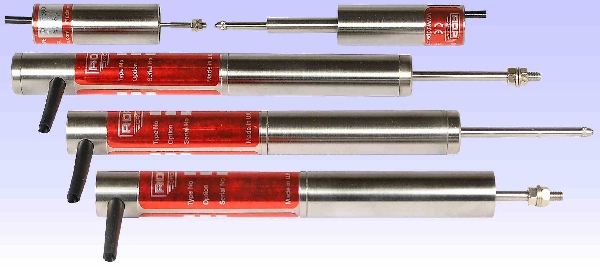 | | These transducers are for displacement / position measurement. They make an accurate position measurement of the movement of the armature (the sliding part) relative to the body of the displacement transducer. This transducer uses the Linear Variable Differential Transformer (LVDT) principle which means that it is probably the most robust and reliable position sensor type available. The strength of the LVDT sensor's principle is that there is no electrical contact across the transducer position sensing element which for the user of the sensor means clean data, infinite resolution and a very long life. Our submersible displacement transducers are designed to make measurements whilst submerged in suitable liquids. Fluids which are non-magnetic can be allowed to flood the armature tube without affecting the operation of the transducer. The LVDTs are available as either unguided or spring return versions. |
| Model DCTH variants | Range |
|---|
| Unguided core, axial cable exit | ±2.5mm to ±10mm | | Unguided core, radial cable exit | ±12.5mm to ±200mm | | Captive guided core, radial cable exit | ±12.5mm to ±470mm | | Spring return core, axial cable exit | ±2.5mm to ±10mm | | Spring return core, radial cable exit | ±12.5mm to ±75mm |
| DCTH Basic Specification | Values |
|---|
| Supply voltage (dual) | ±12V to ±20V 30mA | | Supply voltage (single, must be floating) | 24V to 40V 30mA | | Change in output for change in supply | 5mV/V | | Output 1 | 0V to 10V (+0% - 5%) | | Output 2 | ±5V (+0% - 5%) | | Output load | 10kΩ | | Output ripple | 30mV (peak-to-peak) | | Analogue output bandwidth | 200Hz | | Output impedance | 2 Ω | | Linearity error (Standard) | ±±0.5% F.S. | | Linearity error (Optional on some models) | ±0.25% F.S. | | Linearity error (Optional on some models) | ±±0.1% F.S. | | Temperature coefficient (span) | ±0.03% F.S. /? (typical) | | Operating temperature range | -40° to 80° | | Electrical termination | 2m (integral cable) Longer available to order. |
RDP SSD Series Seawater Submersible LVDT Displacement Transducer
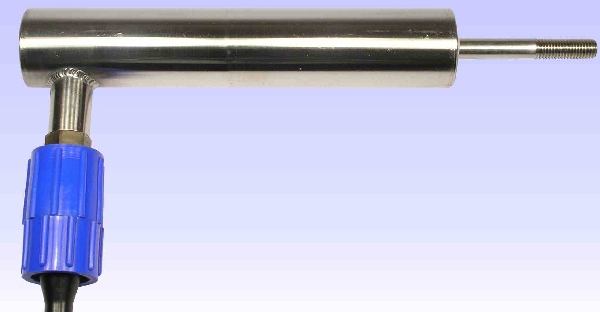 | These transducers are for displacement / position measurement. They make an accurate position measurement of the movement of the armature (the sliding part) relative to the body of the displacement transducer. This transducer uses the Linear Variable Differential Transformer (LVDT) principle which means that it is probably the most robust and reliable position sensor type available. The strength of the LVDT sensor's principle is that there is no electrical contact across the transducer position sensing element which for the user of the sensor means clean data, infinite resolution and a very long life. Our submersible displacement transducers are designed to make measurements whilst submerged in suitable liquids. Fluids which are non-magnetic can be allowed to flood the armature tube without affecting the operation of the transducer. The SS series LVDTs are specially designed for use in sea water and heavy industrial environments with some corrosive chemicals. These LVDTs are made of welded 316 stainless steel and have a through bore plus very heavy construction. Therefore, the SS series LVDTs are capable of withstanding the most arduous industrial applications as well as 10 years seawater submersion at a depth of up to 2.3km. |
| Model SSD variants | Range |
|---|
| Unguided core, radial cable exit | ±12.5mm to ±100mm |
| SSD Basic Specification | Values - Voltage output |
|---|
| Supply voltage (dual) | ±12V to ±20V, 30mA | | Supply voltage (single, must be floating) | 12V to 36V | | Change in output for change in supply | 5mV/V (typical) | | Output | ±5V (standard), 0 to 10V (optional) | | Output ripple | 30mV peak-to-peak (typical) | | Analogue output bandwidth | 200Hz | | SSD Basic Specification | Values - 4-20mA output |
|---|
| Supply voltage (Vs) | 12V to 36V, 30mA | | Max loop resistance | (Supply voltage-11) x 50O | | Output ripple | 50uA (peak-to-peak) | | Analogue output bandwidth | 250Hz | | SSD Basic Specification | Values in common |
|---|
| Temperature coefficient (span) | ±0.03% F.S. /°C (typical) | | Operating temperature range | -10°C to 60°C | | Electrical termination | 2m (integral cable) | | Maximum static pressure | 23MPa |
The unique features of the LVDT. The commendable features of the LVDT arise from the electrically isolated transformer coupled with the non-contacting core. The non-contacting core provides a frictionless measurement. Any measurement that can tolerate a low mass core becomes the ideal target system for LVDT’s. When used for displacement or vibration measurement the absence of friction essentially means there is nothing to wear, leading to a potentially infinite life expectancy. It is also practical to provide models suitable to pressurized measurements including water, corrosive or caustic fluids. Such applications can include flowmeters, densitometers and level detection, including position of flow valves and actuators. A frictionless measurement also provides the realisation of infinite resolution, solely limited by the readability of the external electronics, a situation that continues to improve as the years pass and component quality improves. The inherent symmetry of the LVDT construction provides for excellent null repeatability. The null position is extremely stable and repeatable which provides the ideal solution for high gain closed loop control systems. Again, as the years pass, improved winding techniques have provided consistent symmetrical coils and more perfect null points. The DC LVDT The miniaturisation of electronics led to the provision of DC LVDT’s. Manufactures were able to optimise the windings and electronics to provide the market - With a lower cost LVDT system.
- With optimise design offering good sensitivity and linearity.
- With ease of use and installation.
The AC LVDT While the overall cost of an AC LVDT plus power supply and control circuit is greater than a DC LVDT there remains reasons to employ AC LVDT’s. - Standard AC LVDT excitation / amplifier modules offer a range of excitation frequencies which in turn alter the sensitivity and output of the LVDT. This easy customisation of the response curve may be useful in the lab and may also improve the control in a field installation.
- In installations where unavoidable damage to the LVDT may occur the replacement of only the LVDT costs less.
- The addition of safety features and alarm monitoring in some excitation / amplifier modules.
Unguided, guided and captive cores. The choice is probably obvious to the user. One important point is that an unguided core must be used with the LVDT and calibration chart provided and must be inserted the with the correct end to the top. While a replacement core can be purchased the user should recalibrate the new combination. The manufacture and annealing of a core are time and energy consuming processes and replacements are surprisingly expensive.
|